|
HOME
> CENTRAL TAIWAN > TAICHUNG
> ARTICLES >
COMPASS
MAGAZINE, SEPTEMBER 2001. VOL. 8 ISSUE 9
 |
Chi
Chi Rebuilt: Returning to the Epicenter of the 9-21 Earthquake |
By Cheryl Robbins Translated
by Rachel Chiou
Two years ago, on September
21, 1999, Chi Chi was the epicenter of the devastating, unforgettable
7.6 earthquake that left thousands dead, and thousands more injured
and homeless. Hear from some of the Chi Chi
residents.
Today, Chi Chi appears
to have made a good recovery with many homes and businesses already
rebuilt and occupied and new tourist facilities completed. During
the rebuilding process, the emphasis was placed on improving the
quality of life for residents and attracting tourists. Although
Chi Chi is a small town, with a population of only about 12,000,
there is enough to do here to create a great weekend getaway. Fortunately,
I had my personal tour guide, local resident Chen Dao-chen, who
helpfully showed me around his hometown.
| Probably
the first stop for most tourists is the Chi Chi train station
(located at the corner of Min Sheng Rd. and Min Chuan Rd.).
This station was originally built in 1933 and is one of only
a few wooden, Japanese colonial era train stations in Taiwan.
Although this landmark was very badly damaged during the 9-21
earthquake, it was rebuilt and will officially re-open this
month. |
|
A popular tourist activity
is to take the narrow gauge railroad from the Chi Chi station to
Er Shui or Shui Li. A one-way trip to Shui Li takes about 10 minutes
and costs only about NT$15 per person. A one-way trip to Er Shui
takes about 50 minutes and costs about NT$30 per person. At the
time Compass went to press, the train schedule was undergoing changes.
For current departure times, check at the Chi Chi Train Station.
Beginning in front of
the train station and running parallel to the train tracks is a
picturesque 1.6-kilometer bike path, complete with artistic sculptures
and Victorian-style street lamps. Single-person and tandem bikes
are available for rent for NT$50 per person at two shops located
across the street from the station.
This path ends at Ming
Hsin Hsu Yuan (4, Tung Chang Lane, Yung Chang Li; tel: 049-2762374),
a temple devoted to scholars. This is where students go to pray
for good grades and test scores. Built during the Ching Dynasty,
Ming Hsin Hsu Yuan was originally a school. The three-sided compound
includes a main building, which is now the temple area, and side
rooms. These side rooms house a library decorated in Ching Dynasty
style as well as classrooms, reminders of its earlier days.
|
|
The
Taiwan Endemic Species Research Institute (1, Min Sheng East
Rd.; tel: 049-2761331; open 9 am-4:30 pm Tuesday-Sunday) rubs
up against Ming Hsin Hsu Yuan. The purpose of this institute
is to survey Taiwan's endemic species and promote conservation
of Taiwan's unique ecosystems. This institute includes an exhibition
hall and outdoor gardens. Exhibition areas include "Taiwan's
Ecosystems", "Taiwan's Endemic Animals", "Taiwan's |
| Endemic
Plants", and "Environmental Conservation". In
addition, there are hands-on nature classrooms for students
and pre-school children, special exhibit galleries and theaters.
Admission is NT$50 for adults and NT$30 for children. |
| |
|
From
the Taiwan Endemic Species Research Institute, take Min Sheng
East Road toward the train station. Turn right onto Min Sheng
Road, then turn right again onto Pa Chang Street. Follow this
street until you reach the Wu Chang Gung Earthquake Memorial
(89, Lane 34, Min Sheng Rd.; tel: 049-2762496, 2764229). This
is a temple that collapsed during the 9-21 earthquake. As one
Chi Chi resident aptly described it, the temple appears to have
simply "sat down". It is being left |
| unrepaired
to serve as a memorial to the earthquake victims. Across the
street from this temple is a temporary housing community that
includes the Chi Chi Police Station, comprised of pre-fab buildings
set up during the aftermath of the 9-21 earthquake. |
| |
| From
the Wu Chang Gung Earthquake Memorial turn left onto Pa Chang
Street, then turn left again onto Huan Shan Street. Follow this
road until you see the sign for the road leading to the Chi
Chi Waterfall. Turn right onto this small road and follow it
up a steep hill. In the dry season, this waterfall is nothing
more than a trickle, but it becomes spectacular after a heavy
rain. Near the waterfall are gazebos for enjoying the surrounding
quiet and hillside scenery. Behind the waterfall is a small
cave temple. |
|
| |
 |
Going
back down the hill, turn left onto Huan Shan Street. Continue
on this road as it narrows and winds its way up into the hills.
A 10 or 15-minute drive will bring you to the Tibetan-style
Chen Kuo Si Buddhist temple and monastery. In addition to the
temple and monastery buildings, there is a Buddhist library
and outdoor gardens. The temple itself is a large domed building
that can be seen from most places in town. The first floor contains
a large Buddhist statue and is used for worship. Upstairs is
a row of Tibetan-style prayer wheels and spectacular views of
the surrounding hills and mountains. |
If you are planning to
stay in Chi Chi overnight, the only large hotel in town is the appropriately
named Chi Chi Hotel (113, Min Sheng Rd.; tel: 049-2760778). Room
rates range from NT$2,500 to NT$3,600. Near the hotel, along Min
Sheng Road, are a number of small restaurants serving simple Chinese
dishes such as fried rice and noodles.
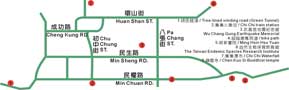
Click
for a larger version
Getting There: From Taichung
take the Taichung-Nantou Highway (No. 63) to the very end. Driving
oneself, take the Chungshan Freeway's Changhua exit and follow the
signs first to Nantou City and then to Ming Chien. From Ming Chien,
take Provincial Highway 16 and follow the signs to Chi Chi. Or,
for a more scenic route from Ming Chien, take Provincial Highway
152, a tree-lined winding road with little traffic.
Chi
Chi Residents Interviewed
|
|
| |
|

Lu Kuai-hua |

Chen Teng-ko |

Yang Feng-yian |
Although
Chi Chi appears well on its way to recovery, many residents
continue to face frustration and hardship. Cheryl Robbins and
Annie Liou sat down with a group of Chi Chi residents, Chen
Teng-ko, Yang Feng-yian and Lu Kuai-hua, and asked them about
the human side of the rebuilding process. Here's how they responded: |
|
| |
|
|
Q:
Looking back over these two years since the 9-21 earthquake,
what are your feelings?
A: A lot of homes collapsed to the point where the
second floor literally became the first floor. If you haven't
experienced that kind of devastation yourself, it is really
hard to understand what it feels like.
Q:
Have the residents of Chi Chi been able to rebuild their lives?
A: A lot of people are still relying on charities for
help. Even the schools were rebuilt through donations. There
are also people living in temporary houses donated by the
Tzu Chi Buddhist Foundation and Nike. Those houses are small
and very hot in the summer. But, the people living in them
don't have the money to rebuild their homes and don't have
the collateral to obtain a loan. The government provided a
subsidy of NT$200,000 for homes that collapsed, but to rebuild
or buy a home takes millions of NT dollars. Some people cannot
come up with that kind of money, so they continue to stay
in temporary shelters. But, the temporary houses are scheduled
for return in February of 2003. It's hard to say what will
happen to those people when the temporary houses are taken
away.
Q:
Why are there so many people still left homeless?
A: In addition to those people who can't afford to
rebuild their home, some people were renting the land their
homes were built on. They owned the house but not the land.
After the earthquake, landlords took the land back leaving
the tenants no place to go.
Q:
Are you optimistic about the future of Chi Chi?
A: Those with the money to rebuild their home are able
to go on with their lives. But, those without money still
have a lot of difficulties to face. The economic downturn
is adding to the hardship. Some people have had to move to
other cities to stay with relatives. But, even with all of
this there is some optimism that things will get better.
|
|
|


