A new special exhibit taking place at the National Museum
of Natural Science sets out to make you rethink your concepts
about dinosaurs. Five hundred and eighty-three objects,
including rare and valuable fossils, reproductions and reconstructed
models and skeletons, are used to tackle some of the most
perplexing questions about dinosaurs.
The National Museum of Natural Science teamed up with the
Institute of Vertebrate Paleontology and Paleoanthropology
of the Academia Sinica of mainland China to present "Dancing
with Dinosaurs, Millenium Dragon Exhibition", in celebration
of the Year of the Dragon. In Chinese, dinosaur is called
'kong long', which means 'terrible dragon'. The dragon has
been an important part of Chinese culture for thousands
of years, serving as a symbol of power and good fortune.
In addition, fossilized bones of vertebrates, most likely
including those of dinosaurs, were originally thought to
be 'dragon bones'. Dragon bones have been ground up and
used in Traditional Chinese Medicine since the Spring and
Autumn Period (770-476BC) for their calcium and other minerals.
Today, more than 100 tons of dragon bones are consumed each
year in China and Southeast Asia. As much as China
is the 'Land of the Dragon' it is also the 'Land of the
Dinosaur'. A number of important dinosaur finds have
come from China, as rocks deposited during the time of the
dinosaurs were laid down on low plains and near rivers and
lakes, providing good preservation conditions for the remains
of land vertebrates. The present climate and topography
at many of the best dinosaur sites facilitate the discovery
and excavation of dinosaur bones. Dinosaur fossils
discovered throughout China provide an almost unbroken record
of the Age of Dinosaurs (from about 228 million years ago
to about 65 million years ago).
 |
Of all of the dinosaur finds from China represented
in this exhibit, one not easily missed is the skeleton
of Mamenchisaurus hochuanensis.
With a length of 22 meters and a height of 13.2 meters,
it holds the Guinness World Record for the tallest
reconstructed dinosaur skeleton. This dinosaur
found in Sichuan Province has a long neck which it
used much as giraffes do to feed on the leaves of
tall trees. It is an odd-looking creature with
a tiny skull and enormous body.
|
There are many questions left to be answered about dinosaurs,
such as how dinosaurs gave birth to young. A number
of fossilized dinosaur nests, found in China, are on display.
Next to each nest is a model of the dinosaur embryo that
would have been found in the eggs of that nest. Compare
the sizes of dinosaur eggs to the size of an ostrich egg.
Also of interest in this area, is the controversy surrounding
Oviraptor. It was originally thought that Oviraptor
fed on the eggs of other dinosaurs. But, in a model created
from the recent discovery of an Oviraptor adult on top of
an Oviraptor nest, it appears that Oviraptor cared for its
young, which might serve to improve its tarnished image
as an egg stealer. Another question is how dinosaurs
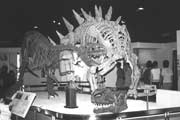
hunted and defended themselves. In the center of this
exhibit are two fight scenes, one between a stegosaurus
and Monolophosaurus (a medium-sized carnivore), and the
other between three Velociraptors and the large Tsintaosaurus
(measuring up to 10 meters in length). Other exhibit units
describe what dinosaurs ate and how they moved.
Page 1 | 2

